Revolusi 48 (Malayan revolution)
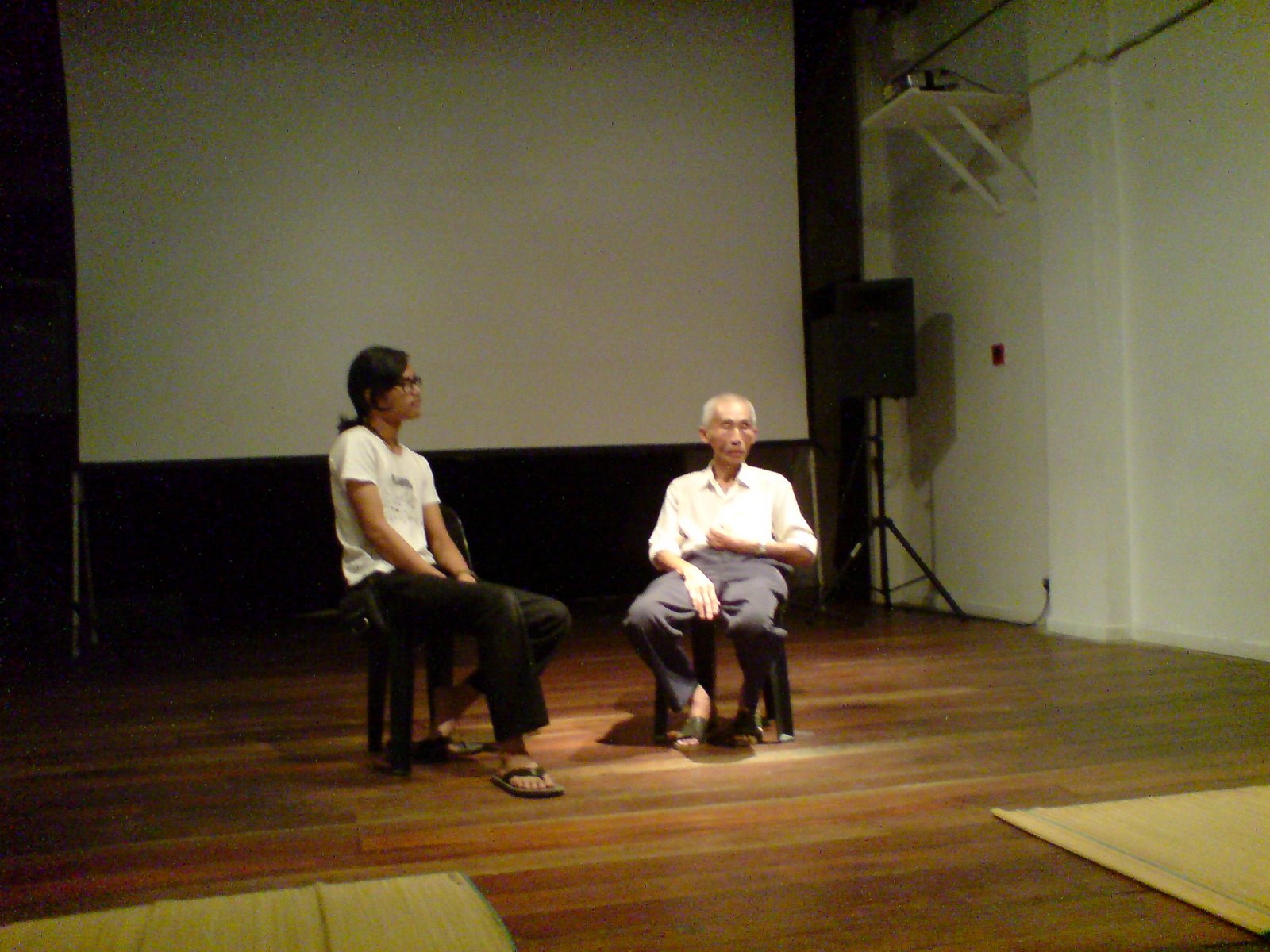
..Fahmi Reza and Pak Mamat 'Cino' (I forgot his real name) at the 'Revolusi 48' film screening at The Annexe, Central Market.
Apologize to fellow blog readers for the long hiatus (syok sendiri kejap).
Anyway, last Friday night I had the chance to watch Fahmi Reza's 'Revolusi 48' film screened at The Annexe Gallery. Four Malayan revolutionary fighters were the VIPs (I can only remember Pak Mamat). The film was actually the first draft and according to director Fahmi Reza, the full film will be released somewhere in November. I feel it is a good film and I enjoy watching it. Reason being is because I think we are still lacking in producing films on historical events.
I like the film, but not the philosophy and ideas. Revolusi 48 is not only an anti-British revolution, but it was in fact a pro Communist revolution, albeit a failed one. And this was obliquely referenced in 'Revolusi 48'. The Malayan revolution in 1948 was also an attempt to turn Malaya into a Communist republic, which didn't go down well with the majority of the population (Turning Malaya into a republic would also mean, dethroning all the 9 Malay Sultans). This could also be the reason why the attempted revolution by the lefties failed. Plus, of course the British were far more superior in terms of size, weaponry and so on.
Some people argue that why they never learn about all these in school? My answer is simple. One, because it was a failed revolution. Two, because it was launched by the Communist. The Malayan Communist had attempted until 1989 to overthrow the democratically elected Malaysian government, launching guerilla attacks from their jungle base, killing our policemen and armed forces and etc. Also, Chin Peng failed to keep his words when he promised to lay down arms if Malaya gain independence, which he did not do, until the peace accord between the Malaysian government and the Communist Party of Malaya (PKM) was signed in 1989. Now, why do we want to glorify the Communist?
This has nothing to do with the government trying to twist historical facts (There are actually a few sentences in the school history book touching on the 1948 event, if you care to read). After all, it is common knowledge that history is always written by victors, isn't it? Go to any bookshop or library, I'm sure there are tonnes of books written on Mao Tse-Tung than Chiang Kai Shek, simply because Chairman Mao was the victor against the nationalist Chiang Kai Shek. And I'm pretty sure there are more books on Che Guevara than former Cuban President, General Batista.
Malaysia, unlike some other countries like America or France, Russia, China, Cuba or even our neighbour, Indonesia, has never tasted 'real' revolution. And this is probably one reason why some of our filmmakers or writers yearn to look for any kind of revolution or anything close to it that happened in our country.
Faisal Tehrani did a similar attempt too when he wrote 'Saasatul Ibaad'. It is a huge attempt by Faisal in telling the story about the so-called Malay revolution during the time of the legendary Sultan Mahmud (Mangkat Dijulang), last descendant of the Sultan of Malacca, who was killed in 1699. Click here to read my comments on the book.
With all due respect to Pak Mamat (pic above), during the Q and A session, he criticised Tunku Abdul Rahman's 'Bapa Kemerdekaan' title. I can understand if some people critise Tunku for being pro-British, but this is the first time that I heard the title was criticised, which I find rather odd. His reason was that the independence that Tunku fought for wasn't by/for the rakyat. Hang on a moment, in 1955 Malaya held its first ever national parliamentary election in which the Alliance party comprising of UMNO-MCA-MIC won convincingly, losing only one seat to PAS. Who voted them? The rakyat of course. The people voted for an independent democratic Malaya, not for a socialist or communist state. Also note that in the 1955 election, the Alliance party manisfesto was to gain independence within 4 years, which Tunku succeeded in just over 2 years without any bloodshed. So why wage war, when you can negotiate? Indonesians by and large are very proud of their bloody revolutionary war against the Dutch but were they better off then compared to us?
Anyways, this blog is not trying to discredit the documentary film, but merely offering an alternative view to it. In my view, Revolusi 48 was nevertheless, a good, well-researched documentary produced. Without doubt, it is way better than Amir Muhammad's controversial documentary film, 'Lelaki Komunis Terakhir'. :)
Comments
You might just want to double-check this (with Mavis Puthucheary, or Azmi Sharom, or any of those other academic types), but I remember that out of some 5-6 mil Malayans, only 1 mil were registered to vote in the first Malayan elections. Or some number like that.
Even if it's only 1mil who voted in the first Malayan election, a resounding majority of them voted for the Alliance.
For the record, in the previous general election, there were around 10mil registered voters out of 26mil Malaysians.
seolah-olah orang tua cina itu memberi amanat khusus kepada kami, 'generasi muda' yang menonton wayang itu untuk 'memelihara' tanah kita ini, yang kian, dilayan seperti dilupakan perjuangan sebenar sebagai rakyat.
In institutions such as UiTM where "Manifesto Kemerdekaan Mahasiswa" includes "Memperjuangkan Ketuanan Melayu Kerana Hanya Melayulah Kaum yang Memperjuangkan Kemerdekaan," I believe films like this can change perspectives, or at least inspire thinking.
But good review offering an unbiased perspective Shahnon!
of course history is written by victors but as touched by Kop and Karl, the perception now that 'Malays are the ultimate race' and 'only Chinese are communists, stigmatize them' or even 'Melayu perlu Sultans dulu, kini dan selamanya' should be given a 360 degree review.
I guess you're an immature blog reader who are unable to accept difference of opinion.
If you don't have any reasons to argue with the blog post above, I think it's better not comment anything. :-)
But thanks though for dropping by, at least I know there are people reading this blog. :-)